In 2024, 2025 and 2026 we talked about the Permanently Progressing study and our findings at 15 national and international conferences, as well as through seminars. These involved practitioners and professionals including social workers, teachers, judges and lawyers, policy makers at the Scottish Government, people that work in the Children’s Hearing system, as well as other researchers and academics.
There has been media coverage across 33 outlets so far, including the BBC, The Herald and STV.
We have also held sessions for people with personal experience of kinship, fostering or adoption, and practitioners who support them through the Association for Fostering, Kinship & Adoption Scotland, CoramBAAF, the Community of Practice for Siblings and organisations that support birth parents. Findings from the study are used at the University of Stirling in programs for social workers and health professionals.
When we talk about our study, we always bring a big bag of shoes. This includes small baby socks, toddler’s first shoes, black primary school shoes, muddy football shoes, sparkly sandals, and large size trainers. We use these shoes to illustrate that our study is about children’s lives and how decisions made and support available (or not) shape children and young people’s lives over time.
The study draws on administrative data, which enables us to provide robust evidence about pathways to permanence for all 1,836 children and young people in our study. However, using big numbers can mean people forget that this is information about real children and young people, and we use the shoes to remind them and engage people’s hearts as well as their heads. For example, when we tell people that by the end of July 2022, it took on average 32 months (almost three years) for 79% of the 1,836 children to live in a home intended to be permanent, we hold up shoes to show what three years mean in the life of a child: from a baby sock to a toddler shoe, from toddler welly boots to a football or ballet shoe.
When telling people that 64% of children (ever looked after away from home) had two or more placements, and one in ten children had five or more, we use an extract from our interviews with children and young people to help people connect to how this feels.
The quote by Ben below (not real name) has been very impactful:
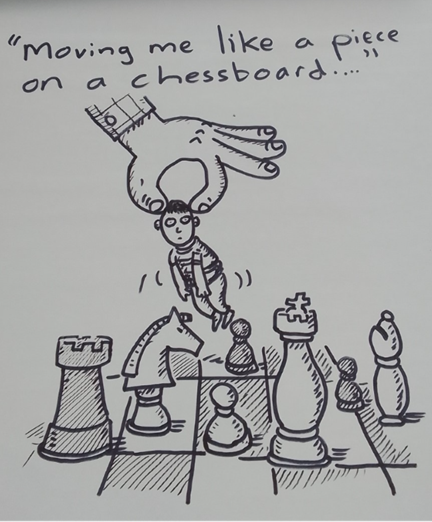
“When I was younger, nobody was telling me what was going on, just moving me, almost like a piece on the chessboard. ‘Just leave him there for now or take him back?’ ‘No, move him here,’ but without saying anything. So, it was just a bit like, ‘You’re here now.’ (Ben, 15 years old)
At one conference Harry Venning (cartoonist) drew this picture when hearing Ben’s quote.
Findings from our study address different areas that require change and improvement. We are mindful to make sure specific findings reach the right audiences. This includes findings on how to support sibling relationships when brothers and sisters live apart; the different support needs of kinship, foster and adoptive parents; what kind of support children, young people and their families find helpful; what is missing across education, health and social work; and how to better support birth parents.
When Phase 2 reported in September 2024, there were two questions in the Scottish parliament which referenced the findings. These related to the need for better educational data for care experienced children and young people. Another question asked why more than one in 10 children and young people were in in temporary placements a decade after entering the care system. Helen, who leads the study, met with Roz McCall MSP in November 2024.
Our study is referenced in and has informed the development of recent guidance such as the Scottish Government Vision Statement (November 2024) Supporting Adoption: A Vision and Priorities for Scotland and AFKA permanence guides.
We are now entering the third phase of the study, but we are continuing to find opportunities to share findings from the two phases completed so far. For example, we have contacted the minister who oversees the Children (Care, Care Experience and Services Planning) (Scotland) Bill. Section 6A of the bill asks Scottish Ministers to review the impact of delays on decisions relating to permanence, including the impact on young children and infants. We hope that evidence from our study about delays and the impact these have will provide a significant contribution to this review.